:root { --deep-blue: #0a192f; --science-cyan: #64ffda; } body { background: var(--deep-blue); color: #ccd6f6; font-family: 'Inter', sans-serif; line-height: 1.8; } .container { max-width: 900px; margin: 0 auto; padding: 80px 20px; } .hero { text-align: center; margin-bottom: 100px; } .hero h1 { font-size: 48px; color: #fff; margin-bottom: 20px; } .hero p { font-size: 20px; color: var(--science-cyan); } .deep-dive { background: rgba(255, 255, 255, 0.05); border-radius: 20px; padding: 40px; border-left: 4px solid var(--science-cyan); margin-bottom: 60px; } .molecular-focus { display: flex; gap: 40px; align-items: center; margin-top: 40px; } .molecular-focus img { width: 300px; border-radius: 15px; box-shadow: 0 20px 40px rgba(0,0,0,0.5); } .trial-badge { background: var(--science-cyan); color: #0a192f; padding: 5px 15px; border-radius: 50px; font-weight: 700; font-size: 14px; text-transform: uppercase; } h2 { color: #fff; margin-top: 50px; } .data-grid { display: grid; grid-template-columns: 1fr 1fr; gap: 30px; margin-top: 40px; } .data-card { background: rgba(100, 255, 218, 0.1); padding: 30px; border-radius: 15px; text-align: center; } .data-card .value { font-size: 36px; font-weight: 800; color: var(--science-cyan); }
Trial #22: Thermal Stability

NutrientShield™ Technology

2km Deep: The Molecular Defense Against Thermal Degradation

Enzyme Recovery
88%
Tỷ lệ phục hồi (Trial #22)
FCR Optimization
1.45
Hệ số chuyển đổi (Mekong Delta)
Thermal Target
95°C
Extrusion Limit Protection

The Challenge: 95°C Extrusion in Tropical Humidity

Modern aquaculture feed production in Southeast Asia, led by giants like C.P. Vietnam and De Heus, requires high extrusion temperatures (90-95°C) to achieve starch gelatinization and pellet stability. However, combined with Vietnam's high ambient humidity, this environment is lethal to exogenous enzymes (Phytase, Protease). Without protection, the Tỷ lệ phục hồi hoạt tính Enzyme (Enzyme Activity Recovery) can drop below 40%, leading to significant nutrient waste and an inflated Hệ số chuyển đổi thức ăn (FCR).

Molecular Encapsulation & Thermal Buffering

Silsep NutrientShield™ utilizes a Mesoporous Silica Matrix specifically engineered for the high-intensity feed mills of the Mekong Delta. Unlike standard carriers, our silica particles feature a precisely controlled pore diameter (2-10nm) that matches the molecular dimensions of key enzymes. Through Van der Waals forces and Electrostatic Anchoring, the enzyme molecules are shielded within the silica "cages," creating a thermal buffer zone that resists the 95°C heat spike during the conditioning and pelleting process.
Silsep Enzyme Shield Mechanics

The "2km Deep" Advantage: Molecular Precision

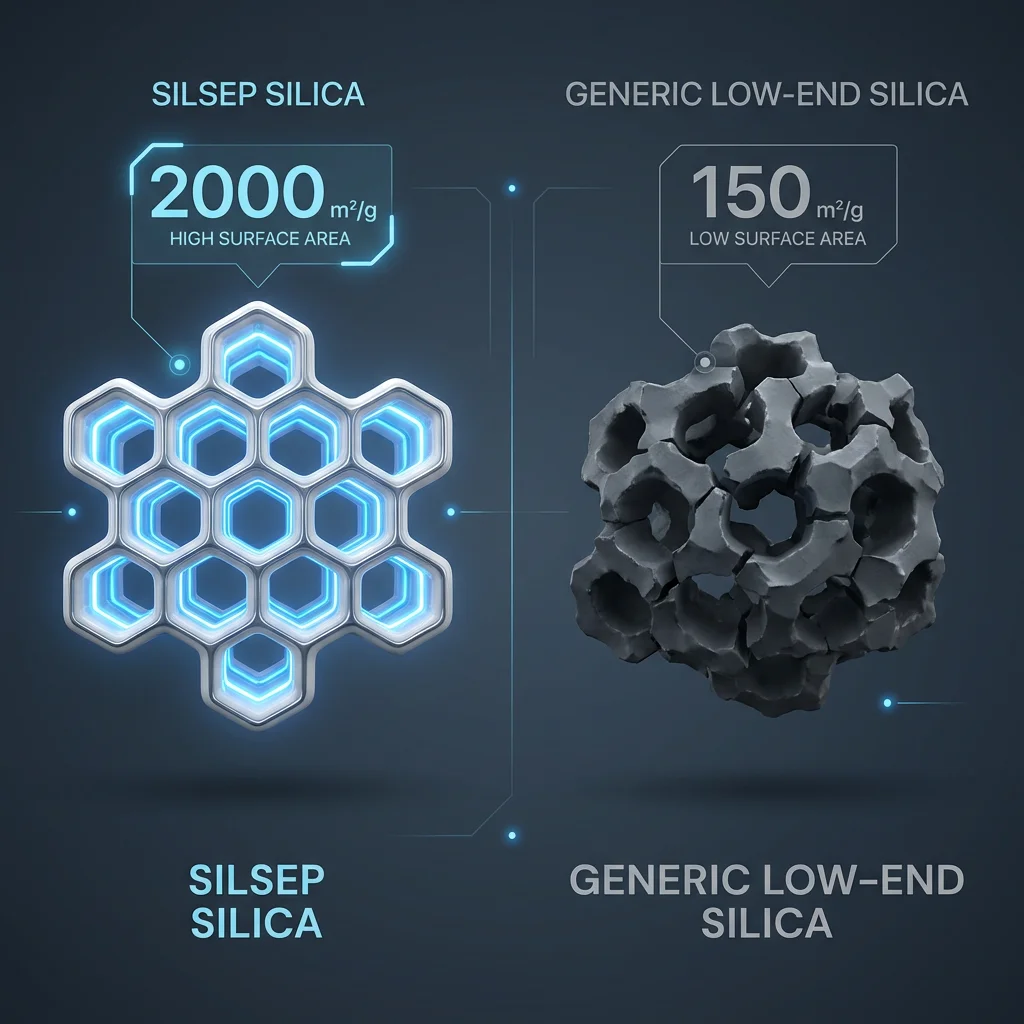
Silica Pore Comparison

Most silica carriers have irregular, "clogged" pores (right) that prevent enzyme loading or offer no thermal protection. Silsep’s synthetic amorphous silica (left) is engineered with an Ordered Hexagonal Mesostructure, providing a massive, accessible internal surface area of up to 500 m²/g for maximum molecular protection.

Scientific Evidence

88%
Enzyme Activity Recovery at 95°C
(Industry Standard: 40%)
-0.17
FCR Improvement in Mekong Trials
(Direct Result of Nutrient Integrity)
Calculate Your Savings with NutrientShield™ →